
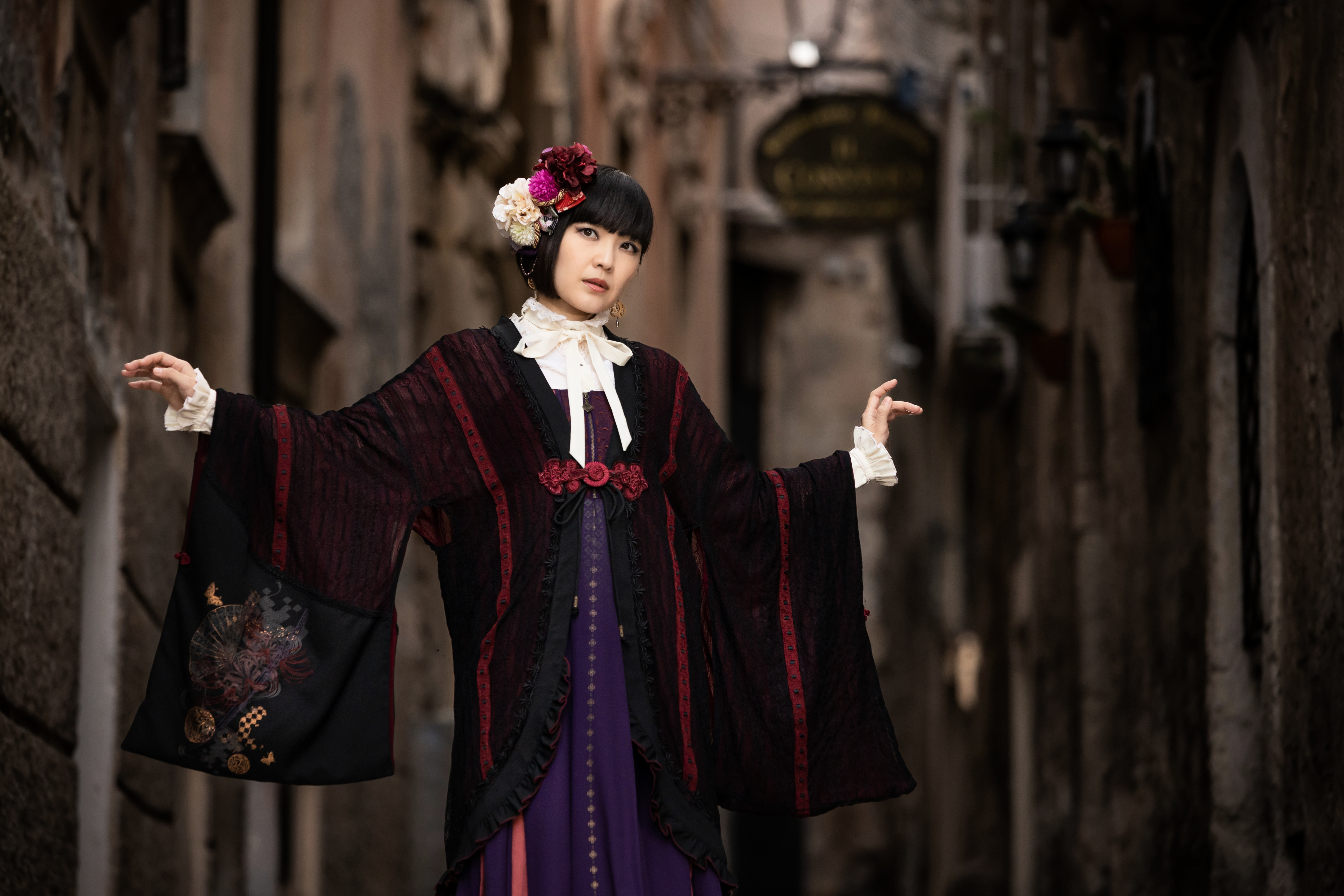
Mika Kobayashi is a singer-songwriter known for her work in anime, video games, and films. In this interview, she shares her journey, creative process, and the stories behind her iconic performances.
Could you please introduce yourself to the readers of Summon the Roses?
My name is Mika Kobayashi, and I am a singer-songwriter. I am usually
based in Tokyo, Japan, where I focus on my activities as an artist, such
as performing live and in concerts with my original songs and producing
albums.
In addition, I also work as a vocalist in collaboration with other
composers and creators. I sing many songs for anime and video game
projects, so overseas fans in particular may know my voice through the
works I have been involved in.
You’ve had an incredible career with projects in anime, video games
and films. How would you describe your journey as an artist?
At the core of my work, I am a singer-songwriter. However, by
participating as a vocalist in a wide variety of genres such as anime,
video games, and films, I have been able to experience the unique worlds
of many different composers and artists.
Through these opportunities, I feel I have been able to broaden my range
and grow as an artist.
You recently released 神遗落的乐章 (The Forgotten Melody of the Gods) on Spotify. What inspired the album, and what can listeners expect?
This new album was born through my music activities in China, which I
have been working on for several years. Specifically, it was a project
proposed by a Chinese agent, with the concept of expressing who I am as
an artist while also showing a new side of Mika Kobayashi.
I hope listeners will enjoy the new world and vocal approaches that
emerged through the challenges of creating this album.
You’ve worked on video game projects like Final Fantasy XI: Seekers
of Adoulin and Xenoblade X. Can you share your experience working on
them?
My involvement in video game projects grew naturally out of my work as a
vocalist. In the case of Final Fantasy, the team had heard my singing in
anime projects and reached out, saying they wanted to work with this
vocalist.
Since Final Fantasy is a globally renowned series, I was truly honored
that the people involved appreciated my voice and that I was able to be
part of the project.
For Xenoblade X, the music production itself took about a year, and I
recorded many of the songs I was asked to sing with great care. The game
was released almost a year after the music was completed, so it became a
very meaningful and memorable project because of the long time and
dedication involved.
Attack on Titan has become a global phenomenon. How did you first
become involved with the project?
As with other anime projects, someone who had heard my singing thought
that I might be able to express a kind of vocal presence that “feels
like a Titan,” and that led to the offer to join the project.
In what ways did working with composer Hiroyuki Sawano on Attack on
Titan influence your musical journey?
It allowed me to challenge myself with new ways of singing that I had
never explored before, and I believe it helped me gain greater variety
in my vocal expression.
Because the anime itself became famous worldwide, I feel happy wherever
I go, knowing that there are people who recognize my voice and singing.
Most of all, it inspired me as an artist to want to challenge myself
with many more kinds of music.
How does the music and visuals in anime impact your performance and
connection with the audience?
The songs I sing are what you would call insert songs that actually play
during scenes in the anime.
So I think that when audiences hear my singing at live shows and
concerts, they often recall their favorite scenes from the anime, and I
can really feel that connection on stage.
How do you train and maintain such a wide vocal range, especially
for pieces that require both delicate and powerful moments?
In my case, I don’t follow any special or specific training routine.
Rather, singing many different songs as part of my work itself becomes
my training for range, volume, and expression.
I believe that working on a wide variety of projects and songs is what
allows me to maintain both a broad range and vocal strength.
Especially when I work with other composers, I receive their ideas and
expressions and return them through my own voice, and I think that
process helps expand my expressive abilities.
Does your vocal technique change depending on the genre or style of
music you’re performing?
Yes, it does.
I always think about what kind of technique best matches each genre and
style.
Can you describe a moment in your career that made you feel
particularly proud of your growth as an artist?
When I perform a solo concert that includes my original songs, anime and
video game music, and works from various collaborations all in one
program, I feel that I have become able to express many different
worlds, both as an artist and as a vocalist.
Are there any artists who have significantly influenced your
creative journey?
I studied classical piano as a child, so even though I have experienced
many different kinds of music, I feel that I have been greatly
influenced by historical classical composers such as Bach and Beethoven.
Outside of music, I also draw a lot of inspiration from stories, so
films and novels, as well as their characters and narratives, often have
a strong influence on me.
Lastly, do you have a message for your fans from around the world?
What I value most as an artist is live concerts.
I always want to go anywhere in the world, not just within Japan, to
sing, and I truly look forward to meeting all of you at live venues.
Please come to my shows and enjoy the music with me.


Leave a Reply